Emberwake
Fly a lantern airship along a burning ridge, lift the survivors out of the towns below, and find a way home when the coal runs out.

Loading the ridge…
How it plays
The Emberwake is a balloon, not a jet: it only moves while you hold the throttle, and it drifts to a stop when you let go — which is how you hover over a town to work the basket. Pay the basket out over someone signalling and it winches them aboard. Concordance skiffs come down the ridge to bomb the towns, and the cannon is a single heavy shot rather than a repeater, so firing it is a decision.
Reach the far end of the ridge with hull to spare and you find a grounded harvester with the keys still in it. The run home is flown in that, through instruments that show you the world as wireframe and pick out the things the Concordance counts as cargo.
Controls
- W or ↑ — climb
- S or ↓ — dive
- A or ← — left
- D or → — right
- B or E — lower the basket, or work the tractor beam
- Space — cannon, or the bomb bay on the run home
On a touch screen the steering pad sits under your right thumb and the two cargo keys under your left.
Every run is generated
There are no art or audio files. The ridge and its caves come from layered noise fields, the meshes are built from primitives when the level is assembled, every town, cave and station is named by a procedural naming service, and the music and effects are synthesised through the Web Audio API. All of it comes from one seed, so a link is a level: the address bar always plays the run you are looking at, and sending it to somebody hands them the same ridge.
Emberwake exists to put those generators under continuous play, where a bad frequency or a dull name generator is obvious in a way a static chart never makes it. It is part of the Kognabo Foundation Lab, alongside Calliope Run and the workbenches for noise, deterministic random, hashing and place naming.
The lab is one building block of Kognabo, a world generated rather than hand-authored. The helpers this ridge is made of are the same ones that world is made of, so flying it is one way of finding out whether they hold up.
How it came about
The game before this one was a single generated island you ran around for forty-five seconds — and an island turns out to be a poor advertisement for a noise field. One shape, one silhouette, not much argument between the layers. Whatever the fields could actually do was not visible from inside it.
So: fly over a whole range instead, and do it in an airship, because the picture in mind was steampunk stories and old role-playing games rather than aircraft — something with an envelope, a boiler and a rope hanging off it.
The brief was a flight simulator: nose forward, land running out to the horizon, caves in the mountains to thread. What came back was a side-scroller, because the agent building it read the request differently. That turned out to suit the actual point better than the intended version would have — from the side you see the whole profile of a ridge at once, which is exactly the thing worth looking at when the question is what the terrain generator does. So it stayed, and the flight simulator is a job for another time.
Everything after that was back and forth. The first ridge was flat, empty and bare. The caves came, then crystals to light them; the towns came, then names for the towns, then signposts to put the names on; pines, boulders, flocks that scatter and hop, survivors who wave a lantern until somebody comes for them. Each one argued for, built, looked at, and usually rebuilt.
The harvester at the far end came last, and is the part that changed the game rather than furnishing it: reaching the end hands you the other side's craft, and the trip home is the same ridge seen through their instruments — the world as an outline, and everything they came for picked out in a colour.
More of it
-
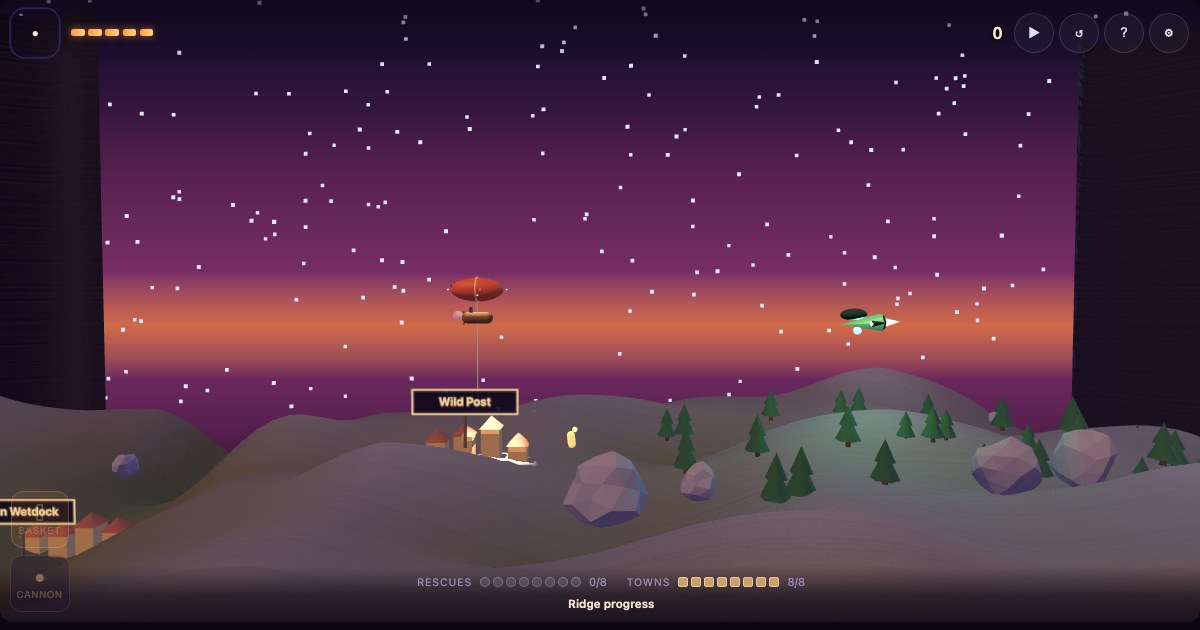
The basket only picks someone up when it is most of the way down, so you have to slow over a town rather than blaze past it. -
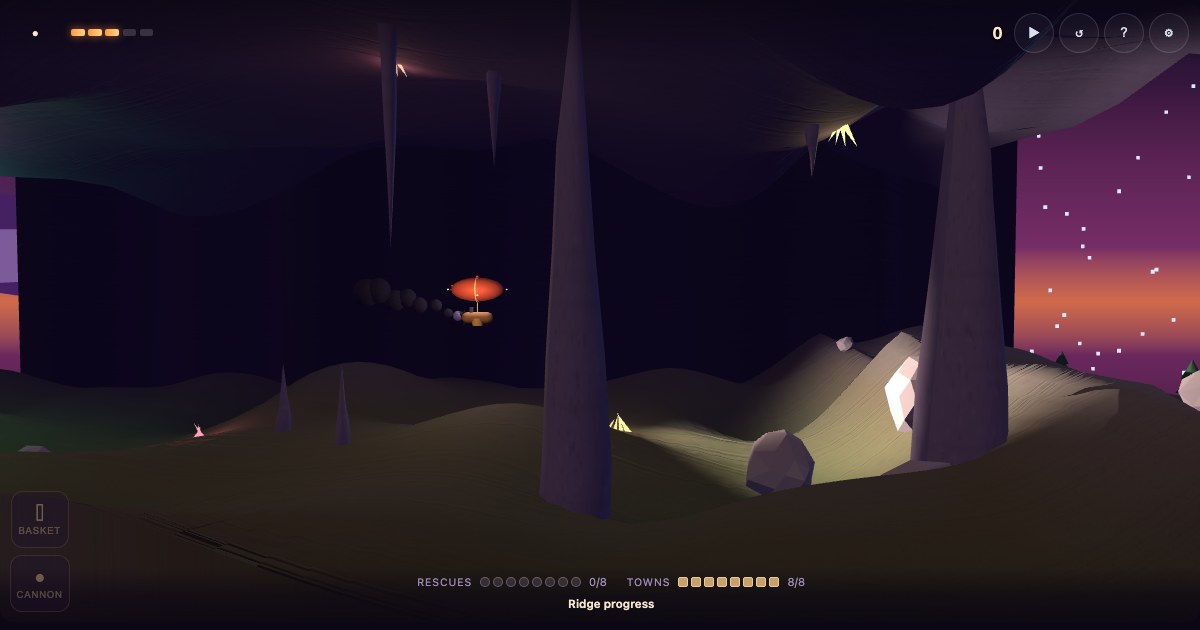
Underground the sky lights nothing, and the headlamp is the only thing showing you the rock you are about to hit. -
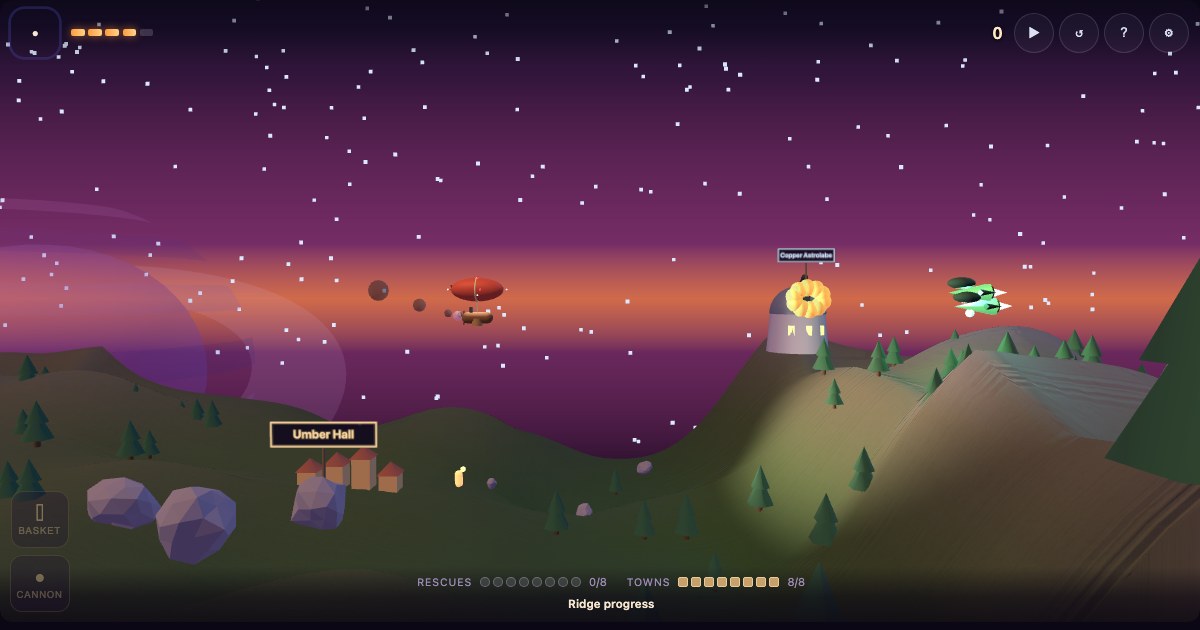
One heavy shot on a long cooldown, so firing is a decision rather than something you hold down. -
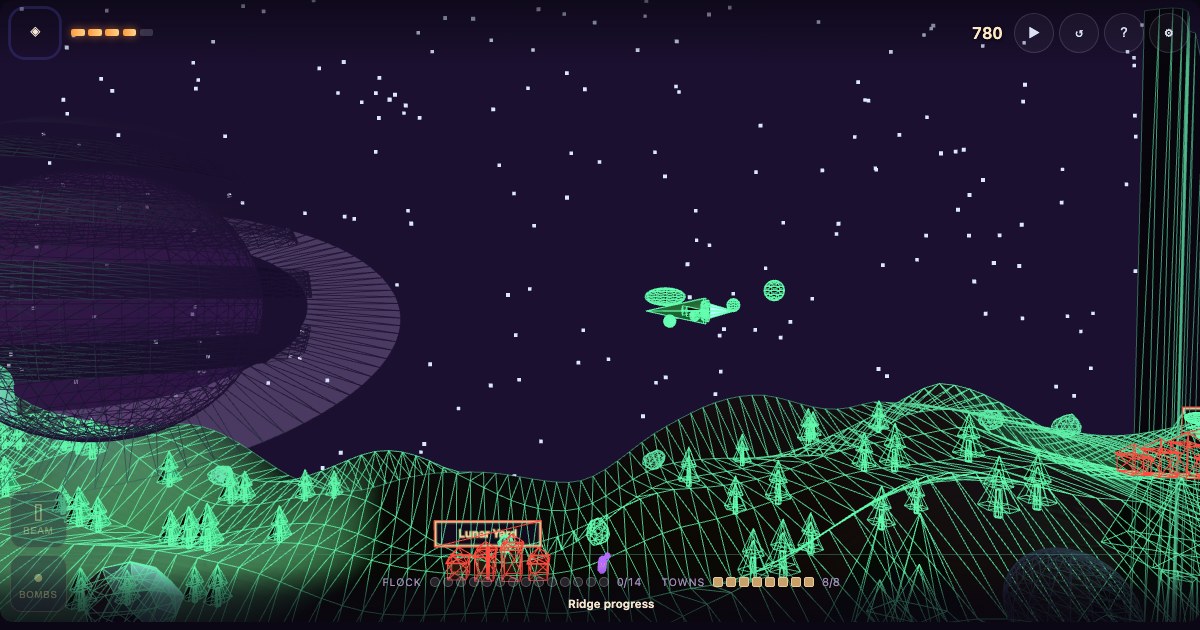
The run home is flown on Concordance instruments. The world is an outline, and the things they count as cargo are picked out in their own colours.


